The Caregiver’s Guide to PD Alarms: 5 Things to Know Before the Next Beep
Here’s a new skill we are sharing because no one has a manual for this: telling the difference between “the machine is being a drama queen” and “okay, this one actually matters.”
If you’re the caregiver for a peritoneal dialysis patient standing in the dark at 2 a.m. trying to decode a beep pattern like it’s Morse code, you’re not alone, and you’re not bad at this. You just haven’t had the cheat sheet yet.
This caregivers guide to PD alarms is that cheat sheet. Bookmark it, screenshot it, send it to your fellow caregivers. Five alarms, five explanations, zero medical jargon.
Our Caregivers Guide to PD Alarms Starts With the 5 You’ll Hear Most
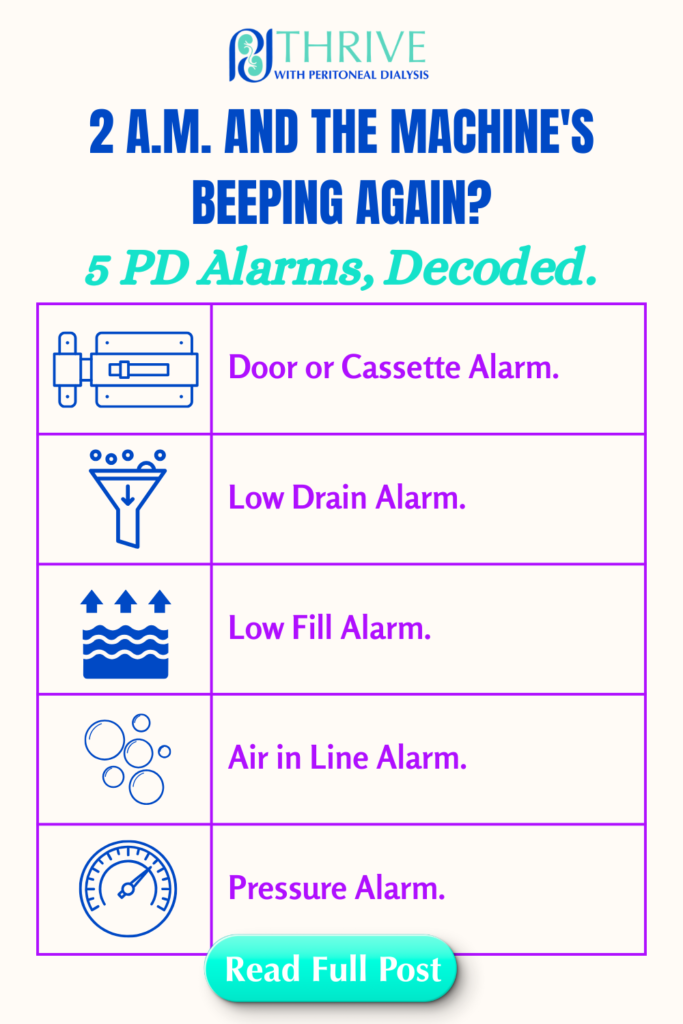
Door or Cassette Alarm. This one means the cycler’s door isn’t latched all the way, or the cassette isn’t seated correctly. (Quick definition if you’re new to this: the cassette is the small plastic cartridge that snaps into the front of most modern cyclers. It’s what actually directs fluid between the bags, the tubing, and your person, so the machine checks that it’s locked in before it’ll run.) It sounds dramatic, but it’s almost always a quick fix: open it, reseat the cassette, close it firmly, and you’re back in business. Treat it like your car’s “seatbelt not clicked in” chime, not a five-alarm fire.
Low Drain Alarm. The machine thinks fluid isn’t draining out fast enough. Check for a kinked tube first, then try having your person shift position. Rolling onto their side or sitting up a little solves this more often than you’d expect. (This is one alarm Kink Free PD™ was built to cut down on – fewer kinks in the line means fewer of these false alarms interrupting your night.)
Low Fill Alarm. Same idea, opposite direction: fluid isn’t flowing in as expected. Scan the line for kinks. A tube pinched under a pillow or body weight causes this more than anything else, which is another scenario Kink Free PD™ is designed to prevent.
Air in Line Alarm. This one spikes anxiety the most, but it’s typically just a small air pocket clearing from the tubing, not a danger sign. The cycler flags it early on purpose, so it gets handled before it’s ever an issue.
Pressure Alarm. The system senses resistance it didn’t expect, often from a kink, a full bladder, or your person’s position. Reposition first, recheck the line second. The fix is usually that simple, and a line that’s less prone to kinking in the first place means you’re reaching for this fix a lot less often.
When This Caregivers Guide to PD Alarms Says: Make the Call
It is time to call your care team, doctor or 911 when there is:
Persistent pain during fill or drain
cloudy or unusual-looking fluid
fever, redness or discharge at the exit site
an alarm that keeps repeating after you’ve tried the obvious fixes
Trust your instinct. Something feeling different from the usual routine isn’t you overreacting; it’s exactly what the on-call line exists for. They are waiting to hear from you, literally.
Most alarms are the machine doing its job, not a sign that something’s falling apart. It’s built cautious on purpose, which means it beeps about plenty of things that resolve themselves in under sixty seconds. Give yourself permission to breathe before you panic. You’ll find the rhythm of it faster than those first few nights make it feel like you will.
And on the nights it still gets your heart racing anyway? That’s normal too. You’re doing a job nobody trained you for, alarm by alarm, night by night. That counts for everything — pass this guide to the next caregiver who needs it, because none of us should have to learn this at 2 a.m. alone.
If tangled, pinched tubing is behind more of your alarms than you’d like to admit, our Kink Free PD™ is built specifically to keep lines flowing the way they’re supposed to — one less 2 a.m. mystery to solve. [Take a look here →]
And if you’re ready to stop troubleshooting one alarm at a time, the full PD Essentials Bundle pairs Kink Free PD™ with the PD Flow Belt™ so your whole setup is working with you around the clock, day shift and night shift alike. [Shop the PD Essentials Bundle →] and get the kind of day-and-night ease that makes this whole routine feel lighter.
caregivers guide to pd alarms, peritoneal dialysis
Kinks, Catheters & Comebacks
A real-life guide to peritoneal dialysis
Practical clarity and real-life guidance – right when you need it most. Get our free guide to peritoneal dialysis – written for patients and caregivers navigating the early days, the hard moments, and everything that comes after.
Inside, you’ll find practical tips, real patient insight, and guidance shaped by lived experience – plus early access to thoughtfully designed solutions that make daily life with PD more manageable.