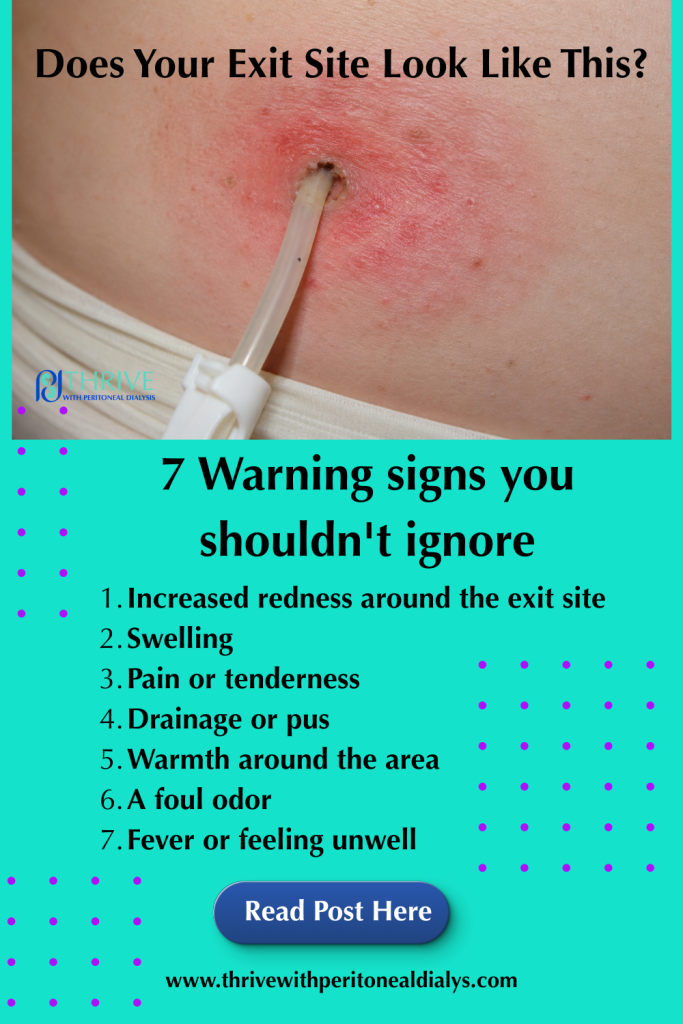
If you’re on peritoneal dialysis, you’ve probably heard the words “exit site infection” more times than you can count.
And if we’re being honest?
Most of us immediately assume the worst whenever we notice something that looks a little different around our catheter.
A little redness.
A little tenderness.
A little drainage.
Suddenly your mind is racing.
The good news is that knowing what to look for—and when to call your care team—can help you catch problems early and protect your treatment.
Your exit site is the place where your PD catheter comes out of your body.
Because the catheter passes through your skin, it’s important to keep the area clean and monitor it regularly.
Sometimes bacteria can enter the area and cause an infection.
The earlier an infection is identified, the easier it usually is to treat.
That’s why paying attention to changes matters.
Call your PD nurse or care team if you notice:
Not every change means you have an infection.
But it’s always worth asking if something doesn’t look or feel right.
Many patients find this part confusing.
A healthy exit site is usually:
The more familiar you become with your normal appearance, the easier it is to recognize when something changes.
Caregiver Tip – Put eyes on your patient’s exit site daily, you notice things they may not. If the slightest thing looks off, call your care nurse – they know exactly how to help this situation!
You don’t need to be perfect.
You just need to be consistent.
A few habits that can help include:
Small habits repeated consistently make a big difference over time.
One of the biggest mistakes patients make is waiting.
They don’t want to bother the clinic.
They think they’ll watch it for another day.
They hope it will go away on its own.
Your care team would much rather answer a simple question today than deal with a bigger problem next week.
If something feels off, make the call – your care nurse is waiting to hear from you and definitely has the answers to help.
Protecting your exit site isn’t only about cleaning it.
It’s also about reducing irritation and unnecessary movement throughout the day.
A catheter that constantly pulls, catches on clothing, or shifts around can make the area feel uncomfortable and draw more attention to the exit site.
That’s one of the reasons we created the PD Essentials Bundle.
By combining the PD Flow Belt™ and Kink Free PD™, the bundle helps support tubing management, comfort, and confidence throughout your PD routine.
Because when your catheter feels secure, it’s easier to focus on living your life—not worrying about it.
👉 Explore the PD Essentials Bundle and discover a more comfortable way to support your PD journey.
More comfort. More confidence. More thriving.