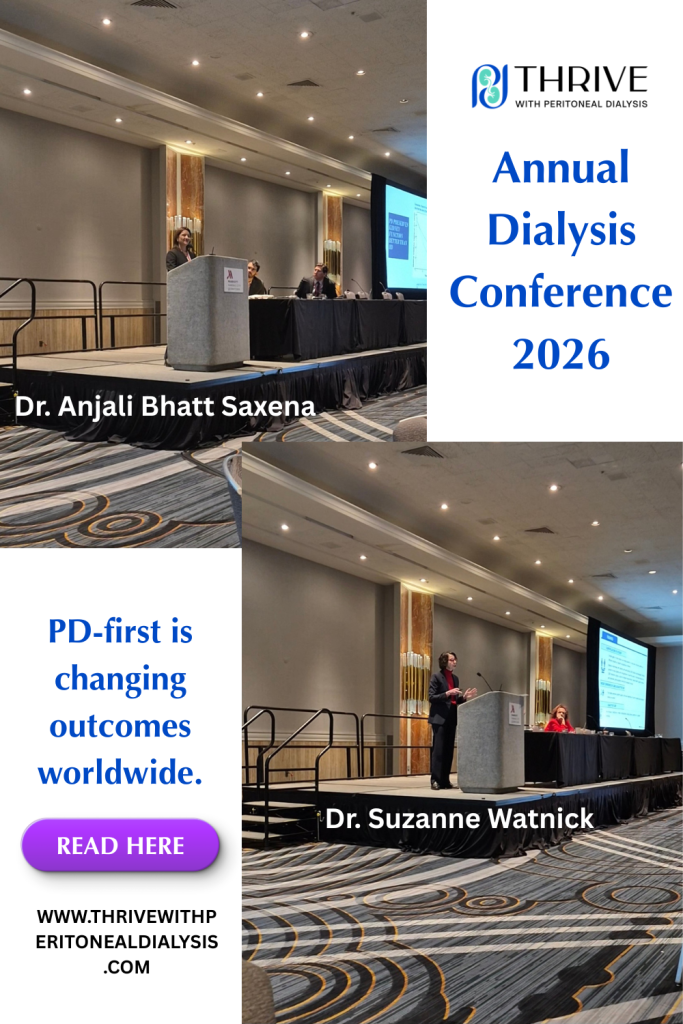
We just got back from Annual Dialysis Conference 2026, and I’m still processing everything I heard.
First—credit where it’s due. The rooms at ADC were incredible, sponsored by the Karl Nolph, MD, Division of Nephrology at the University of Missouri School of Medicine, Vantive, Ardelyx, Natera, and the Missouri Kidney Program. Not just presentations, but real conversations. The kind where you sit there and think:
Why isn’t everyone talking about this?
Because one message came through loud and clear:
We have an opportunity to do dialysis better in this country.
One of the most powerful sessions – by Dr. Anjali Bhatt Saxena – focused on something that feels both obvious… and somehow still not happening in the U.S.:
In many parts of the world, PD is the first option—not the last.
Asia-Pacific regions like Hong Kong and Thailand have implemented PD-first policies, meaning patients are guided toward peritoneal dialysis early in their journey.
And the results?
In Hong Kong, over 70% of dialysis patients are on PD. In Thailand, PD utilization grew from 6% to over 30%—a 400%+ increase after implementing a PD-first model.
Meanwhile, in the U.S., we’re doing the opposite.
In-center hemodialysis is still the default.
Not because it’s always the best fit – but because it’s the system we’ve built.
One of the slides said it plainly:
More patients should be using PD over in-center hemodialysis.
And yet, many patients:
And this is where it gets really important.
This isn’t about saying PD is right for everyone.
It’s about making sure it’s actually presented as an option – early enough for patients to choose what fits their life.
Because when people understand:
Everything changes.
Another incredibly powerful moment came from Dr. Suzanne Watnick’s keynote, Rising Tides or Perfect Storm, where she reinforced what so many in the room already knew:
We are at a turning point.
There are active efforts right now—at a systems and policy level—to shift how kidney failure is approached in the U.S., including advocating for changes in the standard care pathway (protocol) so that PD is introduced first, not last.
At the same time, she shared an important reality check.
Even with programs like the ETC model, which increased training for home dialysis:
Which tells us something critical:
Training alone isn’t enough.
We need:
Because right now, the default is still driving the decision.
If you’re reading this and thinking:
“I didn’t even know PD was an option at first…”
You are not alone.
So many of us find PD later—and wish we had known sooner.
And that’s why this conversation matters so much.
“We have to rethink how we introduce dialysis—because the first option presented often becomes the path a patient takes.”
— Dr. Suzanne Watnick (calling for change in how care begins)
This is bigger than one treatment choice.
It’s about:
And from where I’m standing?
The conversation has started.
The data is there.
And people are pushing—hard—for change.
We’re closer than we’ve ever been.
If you’re navigating PD right now—or just starting to explore your options—our full guide walks you through everything we wish someone had told us, step by step. Start there.
Physicians referenced are not affiliated with or endorsing Thrive or its products.